Day 22-

So when we end up in uncomfortable situations, sometimes we end up saying things we wouldn’t normally say, or maybe even things we don’t really mean. Sometimes we stop listening and as a defense mechanism just try to shut the conversation down. Most times the other person is just looking for someone to listen to them and maybe they are asking you to listen because you are important to them, what they are saying is important to them, OR you just happened to be there when they decide to share it. We have all been there; we have all been the person looking to share and also the person receiving information. Sometimes the information is hard to follow, sometimes it is hard to hear, and sometimes it is hard to give. What really matters though is that we listen. So where am I going with this? In the T1D community we all share with each other the worst things that have been said to us about our disease. Most of the time, these things are said just when we are stating that we have the disease. Sometimes the conversation can start because someone sees our insulin pump or pump site, or they see us checking our BG, or shoving some sort of food in our mouth quickly, or as most of you know I have a medical ID tattoo and sometimes people notice that too. So I have asked some friends if they would share some of the things said to them. Here is goes…“If you just ate healthier it would go away. If you eat healthy and exercise you are cured right? You can only have that if you are a kid right? Are you contagious? If you believed enough you wouldn’t have it. You still have it because deep down you don’t not want it to go away enough. I think you are meant to have it for some reason in life. God wouldn’t give you what you can’t handle. If you believed in Jesus enough you wouldn’t have this disease. Stop being selfish and just eat what everyone else made for you. I made this for you gluten free so you can eat it. I made this for you low calorie so you can eat it. I make this for you low fat so you can eat it. I made this for you so you need to eat it. Do you need to check your blood sugar in front of me? Can’t you inject your insulin in the bathroom, it makes people uncomfortable. It is all just in your head. Can’t you just suck it up? You aren’t going to just die are you? Oh, you should stop eating doughnuts.”

Ok, so I am going to stop there because I could go on, but I feel like you all now get the point. First I want you to now think about someone that has an ailment that is visual, such as a leg amputation, (which can be one of the complications of T1D), and reread those comments leaving out the diabetes specific ones of course.  Again a dynamic shift right? With T1D being an “invisible” disease, meaning unless you see a pump on our arm, you can’t physically tell we have the disease, for some reason people feel much more comfortable saying extremely rude things. Keep in mind NON OF THIS IS OK TO SAY TO ANYONE! This goes for any disease or bodily difference, if you don’t know what to say, don’t say anything at all. If you are curious, most of us don’t mind if you just ask us but start the conversation with an actual question and not an assumption. For instance, what is it like having T1D? Or I am not quite sure what T1D is do you mind telling me? Also a very sweet friend told me last night, that although she didn’t understand because she didn’t have the disease she could give me empathy because that is what she is good at. That meant so much to me. That is what we all want as humans is understanding, for some one to listen. This day and age makes it very easy for us to preach and not listen. That is how we got where we are. That is where anger breeds, is in misunderstanding. Sure I can be angry about what people say to me, but most of it comes from fear and a lack of understanding. Instead, I choose to educate. It takes bravery to ask questions and really, REALLY pay attention to what is going on around us. To learn about the people we are around everyday. Most of the time I find that once you get through the initial awkwardness and misunderstanding people are just curious and want to learn. We all have minds that want to learn and grow. I never expect everyone to know all about T1D, because our brains simply aren’t made to know everything and unless they have personal experience with the disease it is a lot of information to retain in you brain. I do expect though that people treat me, as they would want to be treated and so that is why I do the same.

 

Day 21-

One of my favorite Regina Spector songs starts like this, “ Some days aren’t yours at all, they come and go as if they are some one else’s days”. If you have never heard of her you need to, she is an amazing talented singer/pianist/percussionist/ songwriter. Today I am going to talk about bad days. Not just your regular bad days, T1D bad days. I am going to keep things real, so just a heads up. So a bad T1D day may go something like this, getting ready to do some sort of activity like running, walking, swimming, biking, or even going to a museum or zoo where you are going to walk around a lot and your BG goes low before you get there, then 30 minutes later it goes low, then 30 minutes later it goes low again. Then you finally get it stable and go out to do your thing and then when you get there and get started it goes so low you think you are going to pass out. There goes your whole day. That’s it. It doesn’t matter how much you want to do something if you are going to pass out doing it then it is a no-go. I have gotten ready for a bike ride and started out only to get 1 mile away and then have to ride home, or sometimes not start at all. Or get to a Dr. appointment or work and have by BG so low I am even afraid to get out of the car. This is extremely frustrating because you can see the building; it isn’t that far at all, yet you have to wait for your BG to come up so you don’t pass out on your way in. Also, then you are 10 minutes late for your appointment or work. A bad day is getting out in the middle of the woods alone, have repeated lows, running out of food to treat it with, turning off your pump because you are hoping to hell if you pass out you will eventually wake up because you stopped your pump and are so full of sugar you feel like a gummy bear. You know shit is bad when your dog won’t leave your side. All the exercise things apply to high BG too because, again, if you aren’t getting insulin for some reason, when your BG is high you are at risk of DKA and exercise can push you into DKA quicker in that instance. A bad day is having a crazy morning and forgetting to change your pump site and reservoir, to get out the door and then run out of insulin and then to have to immediately return back home, OR forget to put your pump back on after taking a shower, which does happen occasionally, and then realize an hour later and then return home from where ever you are and feel really, really stupid. A reminder, we are all human. A really bad day is putting a new infusion set in and hitting a vein, because our bodies are full of them, having to pull out the new site because insulin cannot be injected into blood (it will act to fast) and also the new site hurts like a SOB to have it bleed, and bleed, and how the hell can so much blood come out of a tiny hole, and then lay down with a blood soaked towel until it stops (which it does) and then get to put yet another infusion set in. We T1D actually have a name for these vein sites; we call them “gushers”. A bad day is to have an infusion set needles bend as it goes in, it kind of glances off of your skin but still goes in off to the side. Those leave a hell of a bruise. Human skin is amazingly tough, you would be surprised how tough. A bad day is an infusion set leaking due to scar tissue and not knowing exactly how much insulin you missed, was it 2 units, or was it 10? Then having to wait hours to see if you added to correct correction dose. A bad day is having your infusion site or tubing pull out and not know, or have half hanging so again you haven’t been getting insulin and have no idea for how long. Again you have to wait hours to see if you gave yourself enough insulin to correct for the leakage. A bad day is having low BG all night which leads to highs, you conservatively correct the highs, because you’ve been here before, only to go low again and this keeps happening all night into the next day. We call those rollercoaster days. Then you feel like you got hit by a bus and you still have to function all day. A bad day is accidentally sticking your 18g reservoir needle, which is used to get insulin from the bottle to the reservoir through your finger because you slipped. A bad day is having high BG all day and feeling like you have the flu only to have it come crashing down later multiple times. A bad day is having the flu because as you are figuring out now, vomiting and T1D don’t really go well together. If you give yourself insulin for a meal and then throw it all up, well you better get some juice in you so you don’t pass out from a low BG. A bad day is passing out from a low BG, ending up in an ambulance, and at the hospital. The thing about the Glucagon shot is yes it keeps you from dying, but when your BG starts coming back up it is very common for the T1D to start vomiting and also have seizures. I could go on, but I think you all get the point. Regardless of bad T1D days the world keeps turning and we have to keep moving. Most of the time, we suck it up, are glad we are alive, and just keep moving. There are sometimes though that when I am having a really, really hard time I choose to stay home because I am a little unsympathetic to common complaints and would not be proud of what would come out of my mouth. I know this must be all hard to hear and ready, but this is how our lives go, this is how it is. Most days though, we are fine, because please remember this is our “normal” as fucked up as it may be.

Day 20

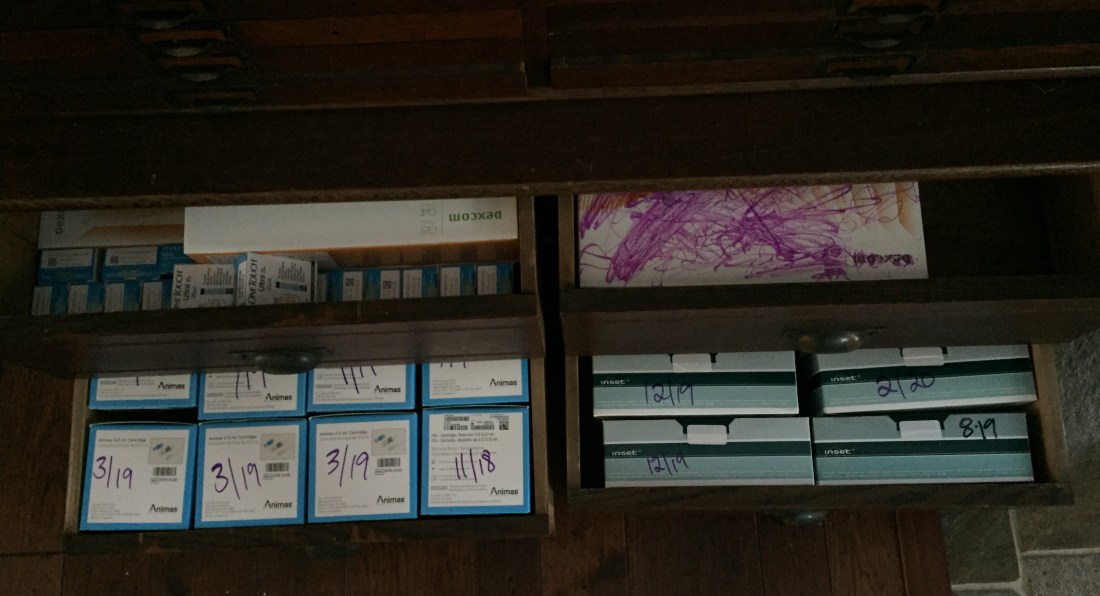
The things we store. You might store some keepsakes, maybe some fishing trophies, maybe some ceramic figurines, and probably definitely some food. You might store books, or maybe your grandmother’s hand embroidered napkins, or your father’s woodworking tools. We T1Ds store supplies, some of them sharp and needle like, some of them not, some liquids, and all of them necessary. So what on earth does T1D have to do with storage? A lot actually! You see quite a few of us receive our prescriptions from medical supply companies and they come in a 90 day supply. Which all means BOXES, boxes of test strips, boxes of infusion sets, boxes of reservoirs, boxes of iv pre pads boxes of batteries, boxes of alcohol pads, and boxes of CGM sensors. Where do we put all of those boxes? There is a joke in the T1D community about their “diabetes cupboard”. Yes folks this takes up at least a whole cupboard, or a cabinet stand, or set of drawers. In addition to all the supplies, we also have to store our insulin in the fridge. Again some of us get 3 month supply, and if we loose power, you guessed we are SOL. Again a reminder, if insulin is refrigerated it is fine for over a year or the expiration date, but once it is room temperature it is only good for 30 days AND cannot be refrigerated again because if it is it will kill the insulin and therefore not work at all. So a lot of us store generators… just for our fridges. With that insulin we all need syringes for back up, just incase our pumps weren’t working and we need to do a manual injection. For those T1Ds that don’t use pumps, they usually use insulin pens, which need refrigeration and pen tips, which are little syringe tips that screw on to the tip of the pens. These usually come in a box of 100. We also store extra lancets for our glucose meter, and also an extra glucose meter or 5. If we have had more than one pump, we only get new ones every 4 years; we store those as back up pumps. Also, even though they are completely functional you can’t give them away… which is the most fucked up thing in the universe. Seriously, I have tried. So I have 3 old insulin pumps that work just fine just sitting in my house with a total of value of $20,000 but since I can’t give them to someone else to use, they are only valued as a back up pump. No I can’t sell them, because they are life saving medical equipment. Back to storage, we store extra charging cables and plugs for our pumps, CGM receivers, and last but not least we store all of our used needles and syringes, aka sharps. Why do we store our sharps? Well we don’t store them forever; we just can’t throw them away everyday because it is a HUGE liability and biohazard. If a garbage man was pricked by used needles, it would be a huge mess, plus a horrible day for the garbage man! So we have to store our sharps in a sharps container until it is full and we can dispose of it property. So yes I have a container of used needles in my house all of the time. Just so you get a concept of how many we go through. A T1D that used syringes or pens would go through around 7+ a day. Also we are supposed to change our lancets every time we check our BG.. or once a day… most of us are bad at that. We can’t throw the old lancets away because they are tiny needles. I change my infusion set every other day and that includes 2 needles, and a cannula that was in my body. Also the CGM is changed once a week or 10 days and that is a huge ass needle. Needles to say we store a lot of sharps. One more thing we get to store is paper work from our appointments and bills for our taxes or for reimbursement from the underinsured program if we are eligible. Yes! This.. is.. so.. much..stuff! So, if you get a nicely wrapped present packaged in an infusion set supply box this Christmas, you will understand why.

Day 19-

Let’s take a turn and talk about new and emerging therapies for T1D. The ones I am going to talk about today do not involve medical devices. Let’s start with smart insulin. They are working on a new insulin that is glucose responsive. Meaning that the smart insulin remains inactive until it senses glucose in the blood and that activates it to start breaking down the glucose until it is at normal levels again. This also means when your blood sugar is low the smart insulin is not active, thus it would allow the liver to release sugars into the blood stream to bring your BG up without the added insulin to bring it back down again which is what happens when you have T1D. This is amazing and began clinical trials in 2015 and is still in the trial mode. There are now other companies trying to come up with similar glucose responsive insulin in different ways. Another thing that has been going on for a while in Argentina and Switzerland is islet cell transplants by way of stem cells. Islet cell transplants have been going on for a while, the problem is that if you have T1D your autoimmune response kicks in and eventually can kill all the islets cells again AND you have to be on immunosuppressant drugs the rest of your life and those have some pretty nasty side effects. So the islet/stem cell transplant begins with your own stem cells and tricks them into mimicking beta cells, which produce insulin, but because they are not actually beta cells they are not killed off as quickly by the autoimmune response. They have found that also since they use the patient’s own stem cells the body responds better to the therapy. This procedure can take up to 4 months before the patient no longer needs synthetic insulin. Yes this is amazing right? Well, it is very expensive and only lasts for so long and that length depends on the individual patient’s immune system 5-20 years. Also, you have to be able to find a Dr. and medical team that is local to you for follow up care… most people can’t just fly across the world for a follow up appointment. So this isn’t practible or affordable for most people with T1D. Lastly I am going to talk about Dr. Faustman’s Lab and the BCG vaccine. This is the trial I was screened for in Boston. So Dr. Faustman has been doing autoimmune and T1D research for a long time. She found a protein that could be injected in mice and it would target the autoimmune infected T-cells in the body and kill them. Thus reversing the autoimmune response. She then realized that the BCG vaccine, the vaccine for tuberculosis that has been around for 100 years, was similar to the protein she was using. It is based on a similar protein. Thus began the trials. The beginning trials began in 2008… this is how long this all takes sometimes folks. Last year the lab was approved to begin human trials and they began this spring. You should know that the BCG vaccine is no longer given in the United States due to our low TB rates. It is still given to infants around the world and is a very safe vaccine. The trial is 5 years long and involves 5-6 injections of the vaccine over that 5 years with follow up appointments. This is all happening at Massachusetts General Hospital. The part of the trial I was screened for involved PET scans. I unfortunately did not have enough c-peptides left in my body to participate in this phase of the study, but I will be participating in another phase starting next year that is for T1D with little to no c-peptides left in their body. So let me say this again, this therapy would reverse the autoimmune response… let that sink in… YES, while they aren’t calling it a cure, it is a reversal. Yes, THIS IS HUGE. Why haven’t you heard about it? Dr. Faustman’s lab doesn’t directly receive any NIH funding and have raised all of the almost $25 million on their own or through small fundraisers. Also this is not a new drug… it has been around for 100 years, it is just a new context to use it. It should also be known that the BCG vaccine is already used to treat some types of bladder cancer and they are already looking into it being used to stop the autoimmune response in MS. I am going to let this all sink in for you. No one has cured any autoimmune disease to date. Now, just so you know, because I don’t have any c-peptides doesn’t mean this is going to work for sure, or that I will be able to go insulin injection free, but I figure even if I start producing some on my own, that is a hell of lot better than none. I am very excited about this but was a little hesitant to share it. You see most of us T1Ds are a little hesitant and cynical when it comes to new treatments and a “cure”. We have heard it all before and have been on the “cusp of finding a cure” for at least 10 years. 10 YEARS people!!! All the while we still need to do what we need to do to take care of ourselves, make sure we don’t have any complications, and try to live a long healthy life with T1D. Also all of this takes soooooooooo long. If I weren’t to be part of the study and say this all does work, it wouldn’t be approved, if it even does get approved by the FDA, for at least 5 years. So I am just crossing my fingers and I will believe it is all happening when I actually go to Boston for that first vaccination.

Day 16-

To sleep, perchance to dream… ah that sleepy beautiful bliss. For T1Ds sleep is often our elusive majestic white stag… we know if it out there somewhere but rarely see it. If sleep is our white stag, deep REM sleep is our Pegasus. Why? Because of BGs being low, BGs being really low, BGs being high, BGs being low and then high and then low, BGs being low and then low and then low and then really high, pump sites being torn off in the middle of the night, cats eating through pump tubing (yes that has happened, my rabbit bit through it too once), getting your arm caught in pump tubing, sleeping on a hard square pump, ALARMS; i.e. pump alarms such as low battery, or low reservoirs, CGM alarms for low BG, CGM alarms for high BG, CGM alarms for high BG that is not really high, CGM alarms a low BG that is actually not low, CGM alarms for really really low BGs that is not low at all, and everything else in normal life. I will explain: So again when your BG goes low your body starts shutting down and to protect itself it will focus on your internal organs and the brain, so sleep isn’t necessary, you usually aren’t sleeping well at all somewhere between sleep and awake and you can wake up freezing, sweaty, shaking, or having a hard time breathing, or I have to go the bathroom really really bad, OR all of the above. I actually will have a hell of a time even falling asleep if my BG is dropping fast. It is so much stress on your body you can’t relax at all. Did I mention the symptoms are ever changing for a low BG? For a while I would wake up and my legs would be cold from the inside, like my body slowed down blood flow to my extremities to take care of my organs (which is what is actually can do) and when my BG would start to go back up after treating it I could feel the warmth start to fill my legs. Yes it was very, very creepy. Luckily that symptom only lasted for a couple of months. Sometime I will wake up from shaking so hard. Sometimes I wake up because I am freezing and sweating buckets. Luckily my body wakes me up, this is not the case for all T1Ds. Remember symptoms are different for everyone. High BGs can wake me up too. Sometimes because I can’t breathe, sometimes because my heart is beating so hard I can feel it and hear in my head, or sometimes because I am so thirsty, or sometimes because I have a headache, OR sometimes from all of the above. Also, like I said earlier lows and highs can occur multiple times a night, over and over like a rollercoaster. When I have nights like these I feel like I have a hangover, got hit by a bus, and was rolled back over all at the same time. My CGM can be fantastic at alerting me, I have it on vibrate now because I sleep through the beeping now and I have to wear it on my so the vibrating wakes me up. The only drawback is with the 20% variance the lows and highs can be inaccurate. So say my CGM goes off because it says my BG is low (70), but when I check my BG with my meter it is actually 100, (not low). I will calibrate my CGM to tell my BG is 100, and then my CGM will alert my BG is low again, (this time is reads 77). If my BG is with target range 80-110 this can happen ALL NIGHT. Also a fun little fact: if my CGM reads that my BG is below 55 (very low), it will beep and vibrate incessantly. This is a very necessary life saving feature, but again comes with the 20% variance. So my BG can actually read 70 by meter, which is low, but not as low as 55 when my CGM reads 55. I treat my lows differently. If my BG is below 60 I have to eat twice as many carbs as if it is 60-80. I have found for me that if it is below 60 it will just keep going down unless I have at least 40 carbs. Again every T1D is different. All this applies to the CGM and high BG readings too. That 20% can make a huge difference. Say it reads my BG as 298, but my meter reads 238. Yes 238 is a bit high, but the insulin dosing to correct it is very different. Also depending on what I am doing, like if I am going to be moving for a while, I would not treat 238 when I would definitely treat 298 with insulin. So some nights I have alarms going off because my BG is low or high and some nights it is going off because it thinks it is low or high. The latter happens more often with low BG readings. So why wear the CGM? Because the pros way outweigh all this and it has saved my live more times I can count. So my pump will alarm every 5 minutes when my reservoir, (the part that holds the insulin), is low until I hit a button to turn it off. It is a very sing-songy alarm but annoying non-the less. Also sometimes, not very often, I forget to change it before I go to bed and it runs out of insulin and then alarms every minute, and rightfully so, so then I get to get up and change my pump site and reservoir. Or say my pump site gets torn off while I am sleeping, and yes that wakes me up because it hurts, and then I have to get up and change the site. That is something I REALLY don’t like to do is wake up in the middle of the night and stab myself with the long-ass infusion set needle and sometime it really hurts. I don’t mind it during the day, but there is something about waking up in the night and inflicting pain on yourself. When my pump needs a new battery I have to rewind the cartridge part where the reservoir goes and act like I am changing my site without actually changing my site. I get to do this in the middle of the night sometimes too. Insulin pumps aren’t very big but they are not comfortable to sleep on at all, they are very hard and have rounded corners, but they are still corners. Also anytime you have something connected to you it is easy to get tangled up in it. Fun times right? There is a running joke with T1Ds that goes with the movie Elf -I got a full forty minutes of sleep last night. Because this is how we feel most of the time. Now, off to bed all this talk of sleep and lack of sleep is making me tired.

Day 4-

So I was going to talk about blood glucose today, but it is another involved thing, so I decided to wait a day and talk about a T1D diagnosis and the autoimmune disease itself. So it is a common myth that T1D only affects children. The fact that the largest fundraising organization for T1D is named the Juvenile Diabetes Research Foundation doesn’t help at all…. When it is true that a majority of people are children, young children, when they are diagnosed it is not true for everyone. ALSO, those children grow up, yes indeed they become adults, and then you have more adults with T1D… crazy right?!?! This is something that most organizations that support research for T1D still have yet to grasp. Yes, believe me, I know how ridiculous this sounds. So this is how the diagnosis happens… you can have the autoimmune gene, or genes, (they have now identified over 50 different ones that can trigger T1D), and they lie dormant…. until something such as a serious illness, tons and tons of stress (internal or external), or an environmental trigger (lots of chemicals) trigger that gene to express itself, and then the autoimmune kicks in. See, it takes some of your awesome T cells and makes them rogue and then they decide to attack your pancreas and kill all of your islet cells, again the cells that produce insulin. This process can take days, weeks, months, or even can take more than a year depending on which straw of life you drew. Really there is no rhyme or reason for the speed of the progression of the disease. So it is common for children to develop the disease simply because their bodies are going through so much constant change through growth, hormones, being exposed to soooo many new germs simply because they are new little people. Other common times someone can be diagnosed are their young 20s, 40s. 60s, or really whenever it happens to you. T1D does NOT age discriminate, or really discriminate at all for that matter. Usually diagnosis happens when a T1D patient is hospitalized for dehydration, flu like symptoms, (DKA), excessive weight loss, or a coma due to DKA. The point is they are really, really sick. I was diagnosed right after my 21 birthday… awesome birthday present right?! I was lucky in a way, I had a physical for a life insurance policy and was turned down because I was a “diabetic” and hadn’t told them, because I had no idea. Sure I had the symptoms but I also had recently sprained my ankle very, very badly and thought I was so tired and achy because I had been on crutches for 2 months. So I quickly was told to go to the Dr., my blood sugar was 513, normal BG is 80-120, and was shown how to check my blood sugar and give myself a shot… boom within 12 hours completely different life. So what would have happened if I hadn’t had that physical? I would have ended up in the hospital within a week. That test literally saved my life. My A1C, which is your average blood glucose over 3 months was 12%, a healthy persons is between 4-6%. Yup, it was a doozy and I was pretty sick for a while. So T1D doesn’t look a certain way, it can affect anyone at any age. Tomorrow I will go into the every fluctuating world of blood sugars/glucose otherwise known as BG. Be ready because it is a rollercoaster of a ride!4-type-1-diabetes-autoimmune-disease-34971