Day 22-

So when we end up in uncomfortable situations, sometimes we end up saying things we wouldn’t normally say, or maybe even things we don’t really mean. Sometimes we stop listening and as a defense mechanism just try to shut the conversation down. Most times the other person is just looking for someone to listen to them and maybe they are asking you to listen because you are important to them, what they are saying is important to them, OR you just happened to be there when they decide to share it. We have all been there; we have all been the person looking to share and also the person receiving information. Sometimes the information is hard to follow, sometimes it is hard to hear, and sometimes it is hard to give. What really matters though is that we listen. So where am I going with this? In the T1D community we all share with each other the worst things that have been said to us about our disease. Most of the time, these things are said just when we are stating that we have the disease. Sometimes the conversation can start because someone sees our insulin pump or pump site, or they see us checking our BG, or shoving some sort of food in our mouth quickly, or as most of you know I have a medical ID tattoo and sometimes people notice that too. So I have asked some friends if they would share some of the things said to them. Here is goes…“If you just ate healthier it would go away. If you eat healthy and exercise you are cured right? You can only have that if you are a kid right? Are you contagious? If you believed enough you wouldn’t have it. You still have it because deep down you don’t not want it to go away enough. I think you are meant to have it for some reason in life. God wouldn’t give you what you can’t handle. If you believed in Jesus enough you wouldn’t have this disease. Stop being selfish and just eat what everyone else made for you. I made this for you gluten free so you can eat it. I made this for you low calorie so you can eat it. I make this for you low fat so you can eat it. I made this for you so you need to eat it. Do you need to check your blood sugar in front of me? Can’t you inject your insulin in the bathroom, it makes people uncomfortable. It is all just in your head. Can’t you just suck it up? You aren’t going to just die are you? Oh, you should stop eating doughnuts.”

Ok, so I am going to stop there because I could go on, but I feel like you all now get the point. First I want you to now think about someone that has an ailment that is visual, such as a leg amputation, (which can be one of the complications of T1D), and reread those comments leaving out the diabetes specific ones of course.  Again a dynamic shift right? With T1D being an “invisible” disease, meaning unless you see a pump on our arm, you can’t physically tell we have the disease, for some reason people feel much more comfortable saying extremely rude things. Keep in mind NON OF THIS IS OK TO SAY TO ANYONE! This goes for any disease or bodily difference, if you don’t know what to say, don’t say anything at all. If you are curious, most of us don’t mind if you just ask us but start the conversation with an actual question and not an assumption. For instance, what is it like having T1D? Or I am not quite sure what T1D is do you mind telling me? Also a very sweet friend told me last night, that although she didn’t understand because she didn’t have the disease she could give me empathy because that is what she is good at. That meant so much to me. That is what we all want as humans is understanding, for some one to listen. This day and age makes it very easy for us to preach and not listen. That is how we got where we are. That is where anger breeds, is in misunderstanding. Sure I can be angry about what people say to me, but most of it comes from fear and a lack of understanding. Instead, I choose to educate. It takes bravery to ask questions and really, REALLY pay attention to what is going on around us. To learn about the people we are around everyday. Most of the time I find that once you get through the initial awkwardness and misunderstanding people are just curious and want to learn. We all have minds that want to learn and grow. I never expect everyone to know all about T1D, because our brains simply aren’t made to know everything and unless they have personal experience with the disease it is a lot of information to retain in you brain. I do expect though that people treat me, as they would want to be treated and so that is why I do the same.

 

Day 21-

One of my favorite Regina Spector songs starts like this, “ Some days aren’t yours at all, they come and go as if they are some one else’s days”. If you have never heard of her you need to, she is an amazing talented singer/pianist/percussionist/ songwriter. Today I am going to talk about bad days. Not just your regular bad days, T1D bad days. I am going to keep things real, so just a heads up. So a bad T1D day may go something like this, getting ready to do some sort of activity like running, walking, swimming, biking, or even going to a museum or zoo where you are going to walk around a lot and your BG goes low before you get there, then 30 minutes later it goes low, then 30 minutes later it goes low again. Then you finally get it stable and go out to do your thing and then when you get there and get started it goes so low you think you are going to pass out. There goes your whole day. That’s it. It doesn’t matter how much you want to do something if you are going to pass out doing it then it is a no-go. I have gotten ready for a bike ride and started out only to get 1 mile away and then have to ride home, or sometimes not start at all. Or get to a Dr. appointment or work and have by BG so low I am even afraid to get out of the car. This is extremely frustrating because you can see the building; it isn’t that far at all, yet you have to wait for your BG to come up so you don’t pass out on your way in. Also, then you are 10 minutes late for your appointment or work. A bad day is getting out in the middle of the woods alone, have repeated lows, running out of food to treat it with, turning off your pump because you are hoping to hell if you pass out you will eventually wake up because you stopped your pump and are so full of sugar you feel like a gummy bear. You know shit is bad when your dog won’t leave your side. All the exercise things apply to high BG too because, again, if you aren’t getting insulin for some reason, when your BG is high you are at risk of DKA and exercise can push you into DKA quicker in that instance. A bad day is having a crazy morning and forgetting to change your pump site and reservoir, to get out the door and then run out of insulin and then to have to immediately return back home, OR forget to put your pump back on after taking a shower, which does happen occasionally, and then realize an hour later and then return home from where ever you are and feel really, really stupid. A reminder, we are all human. A really bad day is putting a new infusion set in and hitting a vein, because our bodies are full of them, having to pull out the new site because insulin cannot be injected into blood (it will act to fast) and also the new site hurts like a SOB to have it bleed, and bleed, and how the hell can so much blood come out of a tiny hole, and then lay down with a blood soaked towel until it stops (which it does) and then get to put yet another infusion set in. We T1D actually have a name for these vein sites; we call them “gushers”. A bad day is to have an infusion set needles bend as it goes in, it kind of glances off of your skin but still goes in off to the side. Those leave a hell of a bruise. Human skin is amazingly tough, you would be surprised how tough. A bad day is an infusion set leaking due to scar tissue and not knowing exactly how much insulin you missed, was it 2 units, or was it 10? Then having to wait hours to see if you added to correct correction dose. A bad day is having your infusion site or tubing pull out and not know, or have half hanging so again you haven’t been getting insulin and have no idea for how long. Again you have to wait hours to see if you gave yourself enough insulin to correct for the leakage. A bad day is having low BG all night which leads to highs, you conservatively correct the highs, because you’ve been here before, only to go low again and this keeps happening all night into the next day. We call those rollercoaster days. Then you feel like you got hit by a bus and you still have to function all day. A bad day is accidentally sticking your 18g reservoir needle, which is used to get insulin from the bottle to the reservoir through your finger because you slipped. A bad day is having high BG all day and feeling like you have the flu only to have it come crashing down later multiple times. A bad day is having the flu because as you are figuring out now, vomiting and T1D don’t really go well together. If you give yourself insulin for a meal and then throw it all up, well you better get some juice in you so you don’t pass out from a low BG. A bad day is passing out from a low BG, ending up in an ambulance, and at the hospital. The thing about the Glucagon shot is yes it keeps you from dying, but when your BG starts coming back up it is very common for the T1D to start vomiting and also have seizures. I could go on, but I think you all get the point. Regardless of bad T1D days the world keeps turning and we have to keep moving. Most of the time, we suck it up, are glad we are alive, and just keep moving. There are sometimes though that when I am having a really, really hard time I choose to stay home because I am a little unsympathetic to common complaints and would not be proud of what would come out of my mouth. I know this must be all hard to hear and ready, but this is how our lives go, this is how it is. Most days though, we are fine, because please remember this is our “normal” as fucked up as it may be.

Day 20

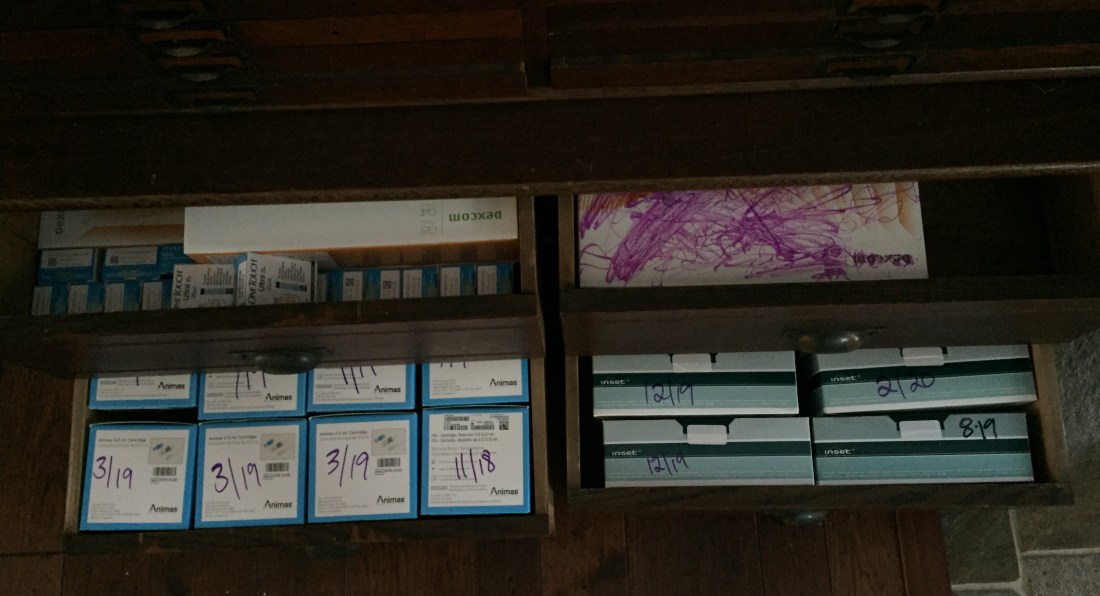
The things we store. You might store some keepsakes, maybe some fishing trophies, maybe some ceramic figurines, and probably definitely some food. You might store books, or maybe your grandmother’s hand embroidered napkins, or your father’s woodworking tools. We T1Ds store supplies, some of them sharp and needle like, some of them not, some liquids, and all of them necessary. So what on earth does T1D have to do with storage? A lot actually! You see quite a few of us receive our prescriptions from medical supply companies and they come in a 90 day supply. Which all means BOXES, boxes of test strips, boxes of infusion sets, boxes of reservoirs, boxes of iv pre pads boxes of batteries, boxes of alcohol pads, and boxes of CGM sensors. Where do we put all of those boxes? There is a joke in the T1D community about their “diabetes cupboard”. Yes folks this takes up at least a whole cupboard, or a cabinet stand, or set of drawers. In addition to all the supplies, we also have to store our insulin in the fridge. Again some of us get 3 month supply, and if we loose power, you guessed we are SOL. Again a reminder, if insulin is refrigerated it is fine for over a year or the expiration date, but once it is room temperature it is only good for 30 days AND cannot be refrigerated again because if it is it will kill the insulin and therefore not work at all. So a lot of us store generators… just for our fridges. With that insulin we all need syringes for back up, just incase our pumps weren’t working and we need to do a manual injection. For those T1Ds that don’t use pumps, they usually use insulin pens, which need refrigeration and pen tips, which are little syringe tips that screw on to the tip of the pens. These usually come in a box of 100. We also store extra lancets for our glucose meter, and also an extra glucose meter or 5. If we have had more than one pump, we only get new ones every 4 years; we store those as back up pumps. Also, even though they are completely functional you can’t give them away… which is the most fucked up thing in the universe. Seriously, I have tried. So I have 3 old insulin pumps that work just fine just sitting in my house with a total of value of $20,000 but since I can’t give them to someone else to use, they are only valued as a back up pump. No I can’t sell them, because they are life saving medical equipment. Back to storage, we store extra charging cables and plugs for our pumps, CGM receivers, and last but not least we store all of our used needles and syringes, aka sharps. Why do we store our sharps? Well we don’t store them forever; we just can’t throw them away everyday because it is a HUGE liability and biohazard. If a garbage man was pricked by used needles, it would be a huge mess, plus a horrible day for the garbage man! So we have to store our sharps in a sharps container until it is full and we can dispose of it property. So yes I have a container of used needles in my house all of the time. Just so you get a concept of how many we go through. A T1D that used syringes or pens would go through around 7+ a day. Also we are supposed to change our lancets every time we check our BG.. or once a day… most of us are bad at that. We can’t throw the old lancets away because they are tiny needles. I change my infusion set every other day and that includes 2 needles, and a cannula that was in my body. Also the CGM is changed once a week or 10 days and that is a huge ass needle. Needles to say we store a lot of sharps. One more thing we get to store is paper work from our appointments and bills for our taxes or for reimbursement from the underinsured program if we are eligible. Yes! This.. is.. so.. much..stuff! So, if you get a nicely wrapped present packaged in an infusion set supply box this Christmas, you will understand why.

Day 19-

Let’s take a turn and talk about new and emerging therapies for T1D. The ones I am going to talk about today do not involve medical devices. Let’s start with smart insulin. They are working on a new insulin that is glucose responsive. Meaning that the smart insulin remains inactive until it senses glucose in the blood and that activates it to start breaking down the glucose until it is at normal levels again. This also means when your blood sugar is low the smart insulin is not active, thus it would allow the liver to release sugars into the blood stream to bring your BG up without the added insulin to bring it back down again which is what happens when you have T1D. This is amazing and began clinical trials in 2015 and is still in the trial mode. There are now other companies trying to come up with similar glucose responsive insulin in different ways. Another thing that has been going on for a while in Argentina and Switzerland is islet cell transplants by way of stem cells. Islet cell transplants have been going on for a while, the problem is that if you have T1D your autoimmune response kicks in and eventually can kill all the islets cells again AND you have to be on immunosuppressant drugs the rest of your life and those have some pretty nasty side effects. So the islet/stem cell transplant begins with your own stem cells and tricks them into mimicking beta cells, which produce insulin, but because they are not actually beta cells they are not killed off as quickly by the autoimmune response. They have found that also since they use the patient’s own stem cells the body responds better to the therapy. This procedure can take up to 4 months before the patient no longer needs synthetic insulin. Yes this is amazing right? Well, it is very expensive and only lasts for so long and that length depends on the individual patient’s immune system 5-20 years. Also, you have to be able to find a Dr. and medical team that is local to you for follow up care… most people can’t just fly across the world for a follow up appointment. So this isn’t practible or affordable for most people with T1D. Lastly I am going to talk about Dr. Faustman’s Lab and the BCG vaccine. This is the trial I was screened for in Boston. So Dr. Faustman has been doing autoimmune and T1D research for a long time. She found a protein that could be injected in mice and it would target the autoimmune infected T-cells in the body and kill them. Thus reversing the autoimmune response. She then realized that the BCG vaccine, the vaccine for tuberculosis that has been around for 100 years, was similar to the protein she was using. It is based on a similar protein. Thus began the trials. The beginning trials began in 2008… this is how long this all takes sometimes folks. Last year the lab was approved to begin human trials and they began this spring. You should know that the BCG vaccine is no longer given in the United States due to our low TB rates. It is still given to infants around the world and is a very safe vaccine. The trial is 5 years long and involves 5-6 injections of the vaccine over that 5 years with follow up appointments. This is all happening at Massachusetts General Hospital. The part of the trial I was screened for involved PET scans. I unfortunately did not have enough c-peptides left in my body to participate in this phase of the study, but I will be participating in another phase starting next year that is for T1D with little to no c-peptides left in their body. So let me say this again, this therapy would reverse the autoimmune response… let that sink in… YES, while they aren’t calling it a cure, it is a reversal. Yes, THIS IS HUGE. Why haven’t you heard about it? Dr. Faustman’s lab doesn’t directly receive any NIH funding and have raised all of the almost $25 million on their own or through small fundraisers. Also this is not a new drug… it has been around for 100 years, it is just a new context to use it. It should also be known that the BCG vaccine is already used to treat some types of bladder cancer and they are already looking into it being used to stop the autoimmune response in MS. I am going to let this all sink in for you. No one has cured any autoimmune disease to date. Now, just so you know, because I don’t have any c-peptides doesn’t mean this is going to work for sure, or that I will be able to go insulin injection free, but I figure even if I start producing some on my own, that is a hell of lot better than none. I am very excited about this but was a little hesitant to share it. You see most of us T1Ds are a little hesitant and cynical when it comes to new treatments and a “cure”. We have heard it all before and have been on the “cusp of finding a cure” for at least 10 years. 10 YEARS people!!! All the while we still need to do what we need to do to take care of ourselves, make sure we don’t have any complications, and try to live a long healthy life with T1D. Also all of this takes soooooooooo long. If I weren’t to be part of the study and say this all does work, it wouldn’t be approved, if it even does get approved by the FDA, for at least 5 years. So I am just crossing my fingers and I will believe it is all happening when I actually go to Boston for that first vaccination.

Day 18-

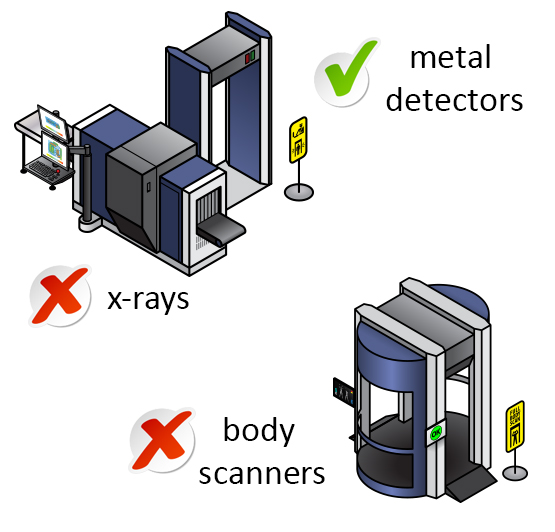
So as kind of a continuation of yesterday, I am going to talk about flight travel today and Transport Security Administration, because, TSA deserves it’s own day. So if you were to have T1D and were going to fly one might think that all the needles and insulin would cause some issues right? Actually, no, TSA and all the security measures actually are pretty easy and straight forward with insulin, syringes, glucose meters, test strips, extra CGM sensors, we can even bring our own unopened juice boxes or gels through security and it is all good. I just have to tell them I have T1D, make sure my insulin has the prescription label, and what bag it is all in. Remember, we have to carry it on with us due to the potential of lost bags, also cargo hold temperature, and we just plain need it with us all of the time. Where the issue comes in, and it is a HUGE issue is the medical devices. Somewhere in their training, and I am so sure it is the longest training in the universe, they were completely misguided about insulin pumps, CGMS when it comes to whole body scanners. So it is very very VERY important to know that both insulin pumps and the transmitters on the CGM CANNOT be exposed to strong magnetic fields, i.e. x-ray and whole body scanners (a form of x-ray). It will actually kill both pumps and the CGM transmitter.. like not work at all immediately. All of the pump companies and CGM companies have issued formal letters saying exactly this. So when I fly I have to opt out of the whole body scanner. Sounds simple right? Nope! Since I am a female I have to wait for a female agent to come pat me down and search me, if I have checked luggage that usually gets searched too, and they have to have me touch my pump and swab me to make sure my pump is not a bomb. Ok, so I understand this is all for security and appreciate them and how hard their jobs are. It is when they ask me why I am opting out that they like to argue, and argue, and argue with me that my pump can go through the machine. Oh, and I mean argue. I have finally gotten to the point where I try not to tell them I have an insulin pump, I just tell them I have a medical devices implanted in me that cannot go through the scanner. Just a FYI pacemakers can’t either, so this isn’t such a foreign concept. I have even tried showing them letter from my pump and CGM companies but that completely doesn’t matter at all. It is all so frustrating and idiotic sometimes I wonder if it is all not for real and just a joke. Please know I don’t mind being searched or being tested for bombs, which is what has to happen when I opt out, but I would love for once to just be able to do that and move on. I will give you some examples of the fun. I was in Huston visiting a friend and doing and a metal demo for her class and was travelling home. I told them I had to opt out, which then we argued about being able to go through the scanner (a lot of times I just tell them if my pump fails they are liable for the $7000 for a new one and that usually works), and I had to wait for a female agent. They proceeded to put me in this 5’ long x 3’ wide x 7’ tall Plexiglas “holding” box in the middle of all the security lines. It was actually pretty funny because the box has holes in a circle in the side to talk through but they looked like breathing holes. The box did not have a top so it was open to the room. So people were swarmed all around this box in TSA security lines and I was standing there barefoot, with pig tails, and a tie-dye t-shirt. One passenger passed me and made a joke about me being a bad person and the TSA agent told him he wasn’t allowed to talk to me. I had to wait about 10 minutes that time, which is actually not that long, and the female agent was very nice, and I went on my way. A lot of times they see my medical alert tattoo while searching me and say “oh”, like seeing my tattoo makes it more legit?!? Recently I flew for a quick trip, less than 24-hour trip to Boston to be screened for a human clinical trial for a new T1D therapy. Don’t worry I will talk about that on a later day. I was leaving from GR, and if you have flown recently you know they have been redoing all their security so it was a mess. I told them I opted out and had plenty of time before my flight. I waited 10 minutes for a female agent, 15 minutes for a female agent, 20 minutes for a female agent, all the while I am just standing off to the side while other passengers are going through the scanner that has a female agent manning it and she is talking to me intermittently. I finally told one of the agents I was going to miss my flight, he proceeded to not do anything and tell me they were doing the best they could. Then another agent came close to me and I told him the same thing and that I had been waiting 25 minutes. He was quiet and then announced that people with medical devices could follow him through the metal detector. Then the female agent said, “Why didn’t you say anything?” as she was searching me and she commented how calm I was. I told her I was screaming on the inside, and really folks if I had screamed and made a scene I would have been detained. As I got to the gate they closed the doors behind me. Yes there are other flights, but this trip was very tight and if I missed it I may have missed the opportunity to be in the trial. Not to mention I am a human being. I understand this is not the agents’ fault and that their training is just wrong. I am not sure how to make it better, except I now get there 3 times as early. I do know that I am not alone in this and have other T1D friends that had similar issues and went through the scanner, trusting the TSA’s knowledge and have their devices fail. It is just all screwed up. So if you want to have a fun adventure, come fly with me… I promise a full demonstration of TSA’s security measures.

Day 5-

Ok, so today we talk about Blood Glucose, aka blood sugar, or just plain BG. Your BG is the level of glucose in your blood…. yes blood. It is measured here in the US mg/Dl. So it gets complicated from the get-go. The standard of a normal BG reading differs from organization to organization. Some organizations say a FASTING BG should be 80-120, others claim 60-110 or 70-100, or, or, or. When you have T1D you use something called a glucose meter to check your BG 8-10 times a day by poking your finger with a tiny needle called a lancet. Yes, I said 8-10 times a day, sometimes it is actually more if you are having a bad BG day or it can be less, but is rarely less. I see you have added up how many holes you can create in your fingers within a week… up to 70… yup that is correct. That is why if I cut myself you bet I get my meter out and check my BG! So, back to the “normal range of fasting BG”. So one of the issues with this is every glucose meter has a range of accuracy. Two different meters can be within 30 points of each other. 30!!!!!!! There goes your whole range. Also every T1D is different. For me, as an example, if my BG is 80 that means it is going down, sinking, man overboard. Very, very rarely do I go up after an 85 or below reading. So if my BG says 70 then I have to treat it as a low BG and have to have some carbohydrates, like juice or I like to use Honey Stinger Gels. But I only have 20-25 carbs to treat it… not a ton or it will go up to much and then my BG will be high. Another problem with having BG on the lower side of normal say 60-80 is you develop something called hypoglycemic unawareness. This is where your BG can be low, very, very low, say 30 and you can’t feel it and you don’t have any symptoms and you can pass out and if no one is there to give you something called a glucagon shot to revive you, you die. Yes, if you become unconscious from low BG and you are not administered glucose in some way you die. Fun times right? Ok, so back to BG target range. After you eat every person’s BG rises as you digest your food. It is only supposed to go up so much, a T1D target range for 2 hours post meal is 150-170 max…. ha ha haaaaaaa they are HILARIOUS! In a perfect world that would work, but something I forgot to mention is EVERYTHING IN THE ENTIRE UNIVERSE AFFECTS YOUR BG if you have T1D… well may be not everything, but pretty damn close! Illnesses, stress, hormones, the weather… yes the weather, sleep, food, exercise, the time of day and what you are doing, any sort of movement, just to name a few. If your heart rate is up your BG is going down, stress can make it either go up or deep seated stress and make it drop or maybe go up or who the F@ck knows.. Also a fun fact, when your BG goes low your liver automatically releases stored glucose to compensate for the low, so if you have T1D then your BG goes up and depending on how much extra glucose you have stored it can go wayyyyyy up, then you wait and give your self insulin to make it come down and then it is low again and you treat it and then we go back up the rollercoaster… so sometimes when you see me and I tell you I am having a bad day, believe me. Having BG all over makes you feel like you are hung over and got hit by a bus, plus if it is at night, say goodbye to any sleep. Oh and the low symptoms are super fun too, dizziness, shortness of breath, brain fuzziness, sensory overload -the frontal lobe of your brain that filters everything shuts down so now you are feeling and hearing every single thing going on around you… lights, noises, wind…. all at once at a high intensity. For a while when I woke up at night with a low BG my legs were cold from the inside out because one of your bodies defense mechanisms when your BG is low is to protect it’s organs and your brain so in return your body shuts down circulation to your extremities. Fortunately, that symptom was short lived. And now we move on to high BG. For a T1D anything over 250 mg/DL is high, meaning that is when organ damage starts happening. You see when you BG is high it actually makes your blood in your veins and arteries thicker, like sludge, so you whole body has to work harder. That is why you hear of Diabetics, T1D and T2D who have had continuously high BGs having serious complications, such as heart disease, eye damage, neuropathy, just to name a few. When your BG is high you heart has to work very hard to pump that sludge. It is no good, no good at all. Also you can end up in DKA, which, I have talked about a lot and the end result can be death. Symptoms of high BG is shortness of breath, thirst, dehydration, brain fogginess, exhaustion, and blurred eye-site because when your BG is high it actually makes the fluid in your eyes behind the lenses thicker and then in-turn pushes on your lenses creating kind of a fish bowl effect. It also affects your depth perception and can take hours to clear up. Just a reminder if you have T1D you use insulin to bring your BG down. So a review Low BG can equal death and high BG can equal death. I am not saying this to be dramatic I am telling you all this because it is a fact and my reality… fun stuff right?! Everyday my number one goal, no joke, is “don’t die”.